
Solar panels on your building’s roof so the whole community pays less for electricity
With shared (collective) self-consumption, one solar installation produces electricity for the common areas and for every neighbour who wants to join. Each participant sees their share deducted on their own bill – without changing supplier and without needing a roof of their own.
- Joining is voluntary
- Everyone keeps their own supplier
- We handle the owners’ meeting and paperwork
What is shared or collective self-consumption?
It is a way of sharing one solar installation between several consumers: the community of owners and the neighbours who decide to take part.
Think of it like a community garden: there is only one garden, but each participant takes home the share of the harvest that was agreed. Here the garden is the solar panels on the roof, and the harvest is the electricity they produce during the day.
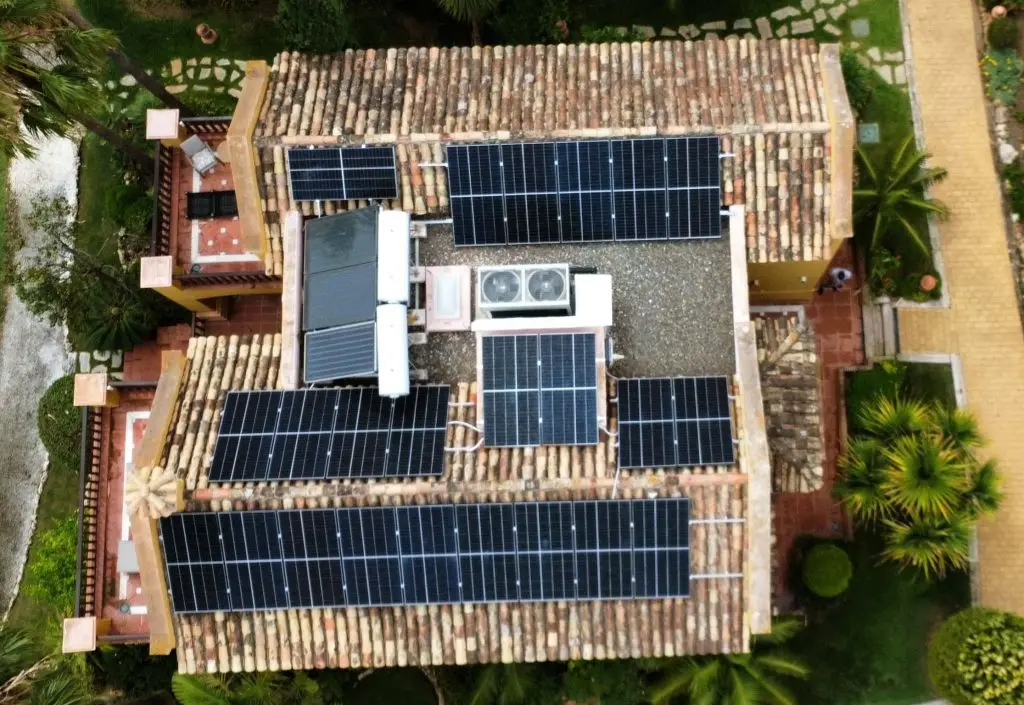
- The panels go on the building’s roof, a car park or another common area.
- The electricity is shared out according to percentages agreed in writing.
- Each participant keeps their own contract and electricity supplier.
- Energy produced but not used at that moment is credited on the bill.
From the roof to your bill: how the energy is shared
The solar plant has its own meter, with its own CUPS code. That meter is linked to the CUPS of every participant, and each one is assigned a sharing coefficient. The plant’s production is then shared out automatically to every linked meter – nobody has to do anything.
The CUPS is the unique code of each electricity meter and appears on every Spanish electricity bill. The grid operator does the sharing using the meters’ hourly readings. Percentages from the example below, for illustration only.
Five steps, from the first idea to a lower bill
It is simpler than it sounds. We prepare the information and handle the paperwork; the community only has to decide.
Free study
We check the roof, calculate how much electricity it can produce and look at the consumption of the common areas and of the interested neighbours.
Owners’ meeting decision
We present the project to the owners with clear figures. Under Spanish law (Ley de Propiedad Horizontal), renewable energy for common use can be approved by one third of the owners representing one third of the participation shares.
Sharing agreement
A simple document is signed stating what percentage of the production goes to the community and to each participating neighbour. We help you draft it.
Installation and paperwork
We install with our own team and handle the permits, the registration of the installation and the communication with the grid operator.
Savings on every bill
From day one, each participant receives their share of solar energy and sees it reflected on their own electricity bill.
Monitoring
The community can follow production from a mobile phone. We remain available for maintenance, warranties and changes of participants.
How is the energy shared?
Imagine a building with 20 apartments that installs panels on its roof terrace. Ten neighbours decide to take part, as well as the community itself.
The community: 30 %
This share powers the lift, the lighting of entrances and garage, the pool pump or the irrigation. If the common-area bill goes down, everyone’s community fees can go down too.
Each participating neighbour: 7 %
The ten neighbours share the remaining 70 %, 7 % each. That energy is deducted from their own bill, without changing supplier.
Tailor-made sharing
The percentages don’t have to be equal: they can depend on what each person invests or consumes, and can even change by hour of the day to make better use of the energy.
Illustrative example. The real percentages are set in each community’s agreement, and savings depend on each participant’s consumption and the space available; your study will show figures for your building.
What it can do for your community
Lower common costs
Lifts, lighting, garages and pumps use most of their electricity during the day – exactly when the panels produce.
Savings for each neighbour
Participants pay less for the electricity they use during the day, even if they live in an apartment with no roof of their own.
Fair and voluntary
Nobody is obliged. Owners who vote against it at the meeting don’t have to pay for the installation, and anyone can join later on the terms agreed.
Tax advantages
In 2026, owners of homes in residential buildings who are Spanish tax residents can deduct 20 % of their investment from their income tax (IRPF), on up to €5,000 a year, and some town halls offer IBI or ICIO rebates. We check what applies to you.
Easier than ever
Since 2026, homes up to 5 km from the installation can also take part, and a new ‘self-consumption manager’ role can handle the paperwork on behalf of everyone.
Put empty space to work
A roof terrace or garage roof that is not used today starts producing clean energy for the building.
Important: solar panels don’t increase your available power
A shared installation reduces the energy that the community and the neighbours buy, but it does not increase the power available in each home or in the building. If the community is planning EV chargers in the garage, new air conditioning or other large equipment, we study the electrical installation and the contracted power and, if needed, propose solutions such as load management.
What communities ask us most
Do all neighbours have to take part?
No. Joining is voluntary. Whoever wants to can take part, and the community can join with its common services. Owners who vote against it at the meeting don’t have to pay for the installation.
What majority is needed at the owners’ meeting?
For renewable energy installations for common use, Spain’s Ley de Propiedad Horizontal requires a favourable vote from one third of the owners who also represent one third of the participation shares. We prepare the information for you to present at the meeting.
Does each neighbour keep their electricity company?
Yes. Each participant keeps their own contract and supplier. Their share of solar energy appears on their own bill.
What happens to the energy that isn’t used?
Energy produced and not used at that moment goes to the grid and is credited on each participant’s bill, according to their percentage and their supplier’s conditions.
Can homes outside the building take part?
In many cases, yes. Since 2026 the rules allow consumers located up to 5 km from solar installations of up to 5 MW to take part. We check what is possible in your urbanisation.
What if a neighbour sells their home or wants to join later?
The sharing agreement can provide for participants joining, leaving or changing. The percentages are updated and the grid operator is notified.
Do we need a battery?
Not necessarily. In communities it usually pays more to use the energy during the day in common areas and homes. If a battery makes sense in your case, we will tell you in the study.
How much could your community save?
Tell us about your building or urbanisation and we will prepare a free, clear study with figures that you can present at your next owners’ meeting.